
Reviewed · BETHLEHEM TOURS
Jerusalem & Bethlehem Tour from Haifa Port 2024 – Small Group
The real appeal here is simple: you can reach Jerusalem and Bethlehem from your cruise ship without arranging separate transport, crossing unfamiliar roads, or worrying about getting back to Haifa Port. The day links major Christian and Jewish holy sites in one ambitious sweep.
I like the small maximum group of 18 and the flexibility a good guide can bring. Guides such as Avi and Abri have been singled out for clear explanations, humor, and smart adjustments when crowds or local events affect the plan. I also like that entrance costs are included, so the $255 price is easier to judge from the start.
The catch is the clock. Jerusalem and Bethlehem are not close to Haifa, and traffic can turn this into a very long day. You may see the main sights, but you should not expect a slow, thorough visit to every corner of Jerusalem’s Old City.
In This Review
- Key points to know before booking
- What $255 buys you from Haifa Port
- Leaving Haifa and managing the cruise clock
- Mount of Olives: the essential Jerusalem view
- Gethsemane and the ancient olive trees
- Mount Zion, King David’s Tomb, and the Last Supper room
- Walking the Old City and the Cardo
- The Via Dolorosa and the Church of the Holy Sepulchre
- The Western Wall and Jerusalem’s Jewish heart
- Bethlehem and the Church of the Nativity
- Guide quality and group size
- What to wear, eat, and carry
- Who should book this shore excursion?
- Should you book the Jerusalem and Bethlehem tour?
- FAQ
- Where does the tour begin?
- How long does the tour last?
- Is pickup from the cruise ship included?
- What information must cruise passengers provide when booking?
- Is lunch included?
- Is transportation air-conditioned?
- What is the maximum group size?
- Can I cancel for a full refund?
Key points to know before booking
- Port-friendly planning: Pickup and return are arranged around your ship’s arrival and re-boarding times.
- Two major destinations in one day: Jerusalem and Bethlehem make this a useful choice for a first visit, but the pace is brisk.
- A strong religious focus: The route centers on biblical and Christian sites, with the Western Wall adding an important Jewish perspective.
- Guides can make or break the day: Avi and Abri have been praised for thoughtful explanations and flexible timing.
- Lunch is not included: Bring money and allow for a meal or snacks during the day.
- Dress carefully: Knees and shoulders must be covered at religious sites, for both men and women.
What $255 buys you from Haifa Port
At $255 per person, this is not a cheap shore outing. It is, however, a practical package if you want Jerusalem and Bethlehem in one day and value a planned return to your ship.
The price includes port pickup, a return transfer, an air-conditioned vehicle, an English-speaking government-licensed guide, and entrance fees listed for the tour. You are not paying separately for each stop, which makes budgeting easier. Food and drinks are extra, and lunch is not provided.
The value depends on your alternative. If you arranged private transport, separate guiding, and port transfers on your own, the total could rise quickly. A small group also gives you a better chance of moving through busy areas than a large coach group.
Still, this is not a leisurely private tour. The group can reach 18 people, and one group of that size may feel crowded in a small vehicle. If personal space, custom pacing, or long visits inside each church matter most to you, a private tour may be a better fit.
The tour is often booked well ahead, with an average booking point of about 53 days before departure. That makes sense for cruise dates, when transport capacity and ship schedules matter.
More bethlehem tours in Haifa:
- Full-Day Holy City of Jerusalem and Bethlehem Private Guided Tour
★ 5.0 · 9 reviews - Haifa Shore Excursion: Private Jerusalem and Bethlehem Day Trip
★ 4.0 · 4 reviews - From Tel Aviv: Jerusalem and Bethlehem Guided Day Trip
★ 4.3 · 1,316 reviews
Leaving Haifa and managing the cruise clock
The guide waits at the exit of the arrival terminal with a COMPASS sign. This detail matters. Look for Compass rather than only your booking platform’s name, since one person had trouble recognizing the correct company at pickup.
You must provide your ship name, docking time, disembarkation time, and re-boarding time when booking. The return transfer is planned around your ship’s schedule, which is one of the strongest reasons to choose a port excursion instead of independent travel.
The drive is the unavoidable tradeoff. One account put the round-trip road time at roughly five hours, though traffic and the day’s exact route will affect that figure. Jerusalem traffic, Bethlehem traffic, security checks, and access rules can all eat into sightseeing time.
That is why you should treat the advertised eight to ten hours as a full shore day, not eight to ten hours of walking around holy places. Wear comfortable shoes, keep your belongings organized, and be ready to board the vehicle promptly after each stop.
Mount of Olives: the essential Jerusalem view
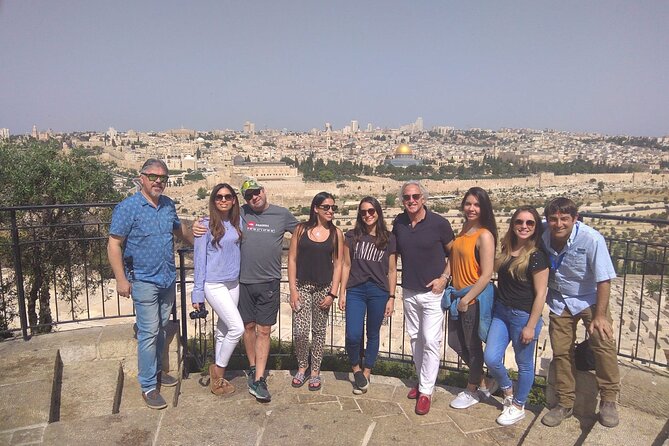
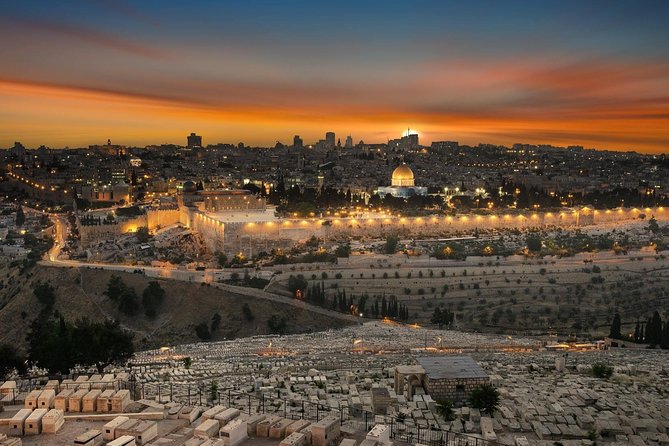
Your first Jerusalem stop is the Mount of Olives, where the city opens below you. The view gives you a useful sense of place before the walking begins, with the Temple Mount area separated from the Judean Desert by the ridge.
For Christians, the Mount of Olives carries special meaning. The New Testament connects it with Jesus’ route to Bethany, his sorrow over Jerusalem, and his ascension into heaven. The guide can explain these connections while pointing out the city’s main landmarks.
The stop lasts about 30 minutes and has no separate admission charge. That is enough for the major view and an introduction, but not for an extended visit to every church or cemetery on the hill.
This is one of the most worthwhile short stops. You get physical orientation, biblical context, and a strong first look at Jerusalem without spending your first hour in narrow streets.
Gethsemane and the ancient olive trees
At the foot of the Mount of Olives, the tour visits the Garden of Gethsemane. According to the four Gospels, this is where Jesus prayed in anguish before his arrest.
There is not one universally agreed garden enclosed behind a single entrance. Several small olive groves on nearby church properties are linked with biblical Gethsemane. The setting is therefore both a place of faith and a reminder that sacred traditions often develop over many centuries.
You have about 30 minutes here. The visit is quiet in purpose, though the actual atmosphere can change with crowds and church schedules. Do not expect a long private meditation, but you will have time to see the olive groves and hear why the site matters.
The short stop works well after the Mount of Olives. You move from a broad city view to a more intimate place tied to the final hours of Jesus’ life.
Same coast, a completely different kind of day:
- From Haifa: Guided Day Trip to Nazareth and Sea of Galilee
★ 3.9 · 51 reviews - Haifa Culinary Private Tour
★ 5.0 · 38 reviews - Haifa Port Shore Excursion: Nazareth and Sea of Galilee Day Tour from Haifa Port
★ 4.0 · 36 reviews - Holy Jerusalem Private Tour
★ 5.0 · 24 reviews
Mount Zion, King David’s Tomb, and the Last Supper room
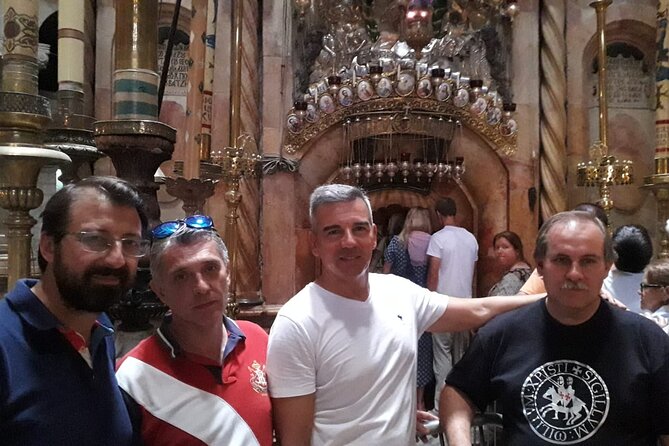
Mount Zion brings together Jewish and Christian traditions. The visit includes King David’s Tomb and the room traditionally associated with the Last Supper.
King David’s Tomb is considered one of the holiest Jewish sites in Jerusalem. The identification is not certain, however. Biblical references place David’s burial in the City of David, lower down near the Temple Mount, so you should see this site as a long-held tradition rather than a proven archaeological fact.
The upper room connected with the Last Supper is also traditional rather than certain in a modern archaeological sense. Its importance comes from religious memory and centuries of pilgrimage.
The tour allows about an hour on Mount Zion. That is useful because the two sites carry different meanings and deserve more than a quick photograph. Keep your clothing respectful, since sacred places may enforce the requirement that knees and shoulders be covered.
Walking the Old City and the Cardo
The Old City is where the day shifts from viewpoints and open courtyards to tight streets, stone passages, and active religious quarters. You enter through the Armenian and Jewish quarters and walk toward the restored Cardo.
The Cardo was a Roman-era road and later a major Byzantine thoroughfare. The southern section visible today was built under Emperor Justinian in the sixth century. It once helped connect important Byzantine churches, including the Church of the Holy Sepulchre and the Nea Church.
The restored section gives you a clear look at Jerusalem beneath the modern city. It is not simply an old street preserved for display. It shows how Roman and Byzantine planners organized this part of town, and how later building covered and reshaped earlier layers.
About an hour is assigned to the Old City section. The pace can be quick, especially when the route must also include the Via Dolorosa, the Holy Sepulchre, and the Western Wall. Your guide’s choices matter here. A flexible guide may adjust the order to make better use of open routes and crowd conditions.
The Via Dolorosa and the Church of the Holy Sepulchre
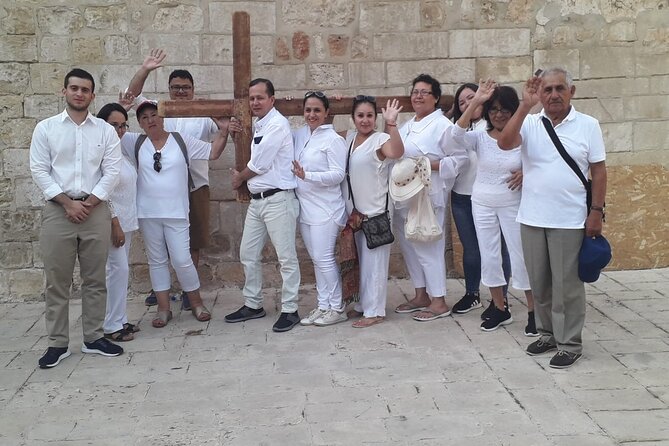
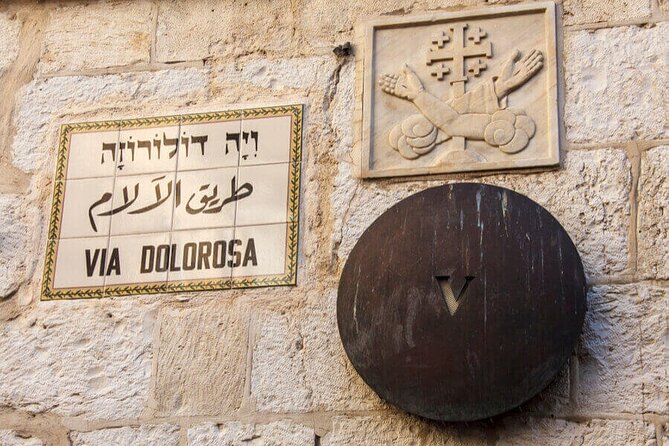
The Christian Quarter brings you onto the Via Dolorosa, the processional route associated with Jesus’ path to crucifixion. The name means Way of Suffering, and the route is marked by Christian traditions connected with the Passion.
The path is narrow and busy in places. It runs through a working part of the Old City, so this is not a silent museum corridor. Shops, worshippers, processions, and ordinary daily life all share the same stone lanes.
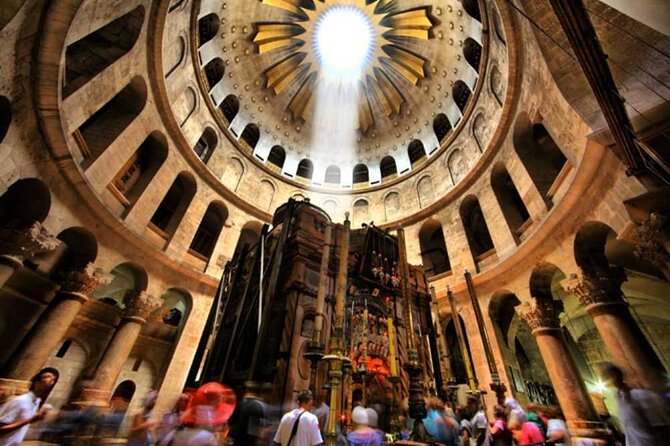
The Church of the Holy Sepulchre is the emotional center of the Jerusalem portion. Christians identify the church with the crucifixion, burial, and resurrection of Jesus. The site linked with Calvary, or Golgotha, is inside the church complex, along with the traditional tomb.
The tour allows about an hour for the Via Dolorosa and another hour for the church. In practice, access may depend on crowds and worship schedules. One of the main risks of this day is arriving late and having only a short time for these central sites.
You should expect a powerful visit, but not necessarily a complete one. Lines and congestion can make the church feel rushed. Stay close to your guide and listen for meeting instructions before entering crowded areas.
The Western Wall and Jerusalem’s Jewish heart
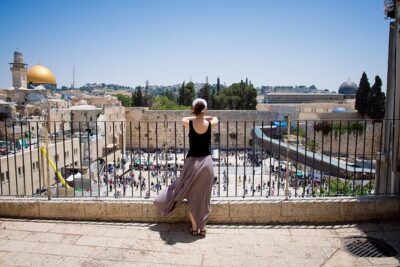
The Western Wall provides a necessary change of focus. This ancient limestone wall is part of a much larger retaining structure near the Temple Mount, and its holiness comes from its closeness to the former Temple complex.
For Jewish worship, the wall is the most accessible place of prayer near the Temple Mount, whose most sacred areas have entry limits. The name Wailing Wall is widely known, but Western Wall or Kotel is the more respectful wording for the site.
The stop lasts about 30 minutes. That is enough to approach the prayer area, observe the traditions, and take in the setting. Dress and behavior matter here. Follow local instructions, keep your voice low, and remember that this remains an active place of worship, not just a sightseeing stop.
The wall may be one of the few Jerusalem sites you see if traffic or crowds force a shortened schedule. That possibility is important when deciding if this combined tour suits you.
Bethlehem and the Church of the Nativity
After Jerusalem, the tour continues to Bethlehem, a Palestinian city in the West Bank. The change in setting adds political and cultural context to a day that could otherwise feel like a series of church visits.
The main stop is the Church of the Nativity and Manger Square. Christian tradition identifies the grotto beneath the church as the birthplace of Jesus. The Gospel accounts of Matthew and Luke place Jesus’ birth in Bethlehem, and the story of the manger gives the site its lasting meaning.
The setting is less like a Christmas card than many first-time visitors expect. The traditional birthplace is a dim rock grotto, not an open field beneath a bright star. That contrast is part of the experience. It brings the story back to a physical place shaped by stone, ritual, and centuries of worship.
Two hours are assigned to Bethlehem, making it the longest single stop. That helps balance the rapid movement through Jerusalem. One person found Bethlehem especially meaningful because the site was not crowded at the time of the visit, though conditions can change from day to day.
Entry and timing may be affected by lines, church services, and local movement. Your guide will need to keep an eye on the clock, since the return to Haifa is tied to your ship.
Guide quality and group size
The guide is the most variable part of this experience. The right guide can turn a demanding day into a clear, memorable introduction. Avi has been praised for combining biblical detail, historical explanation, humor, and flexible planning. Abri has also been noted for getting a small group through several sites efficiently and explaining what you are seeing.
That flexibility matters during holidays and city events. On one date that coincided with Israeli Flag Day, the guide changed the plan to reach the main places while avoiding trouble spots. This is exactly the kind of judgment you need on a port day.
The group limit is 18. That is small compared with a full-size coach, but it is not intimate. A small vehicle may feel tight, especially if seating does not place couples together. One person found the bus cramped when the group reached 17 people.
If the tour fills, expect group movement rather than a private conversation with the guide at every stop. The benefit is a lower price than a private outing and a better chance of moving through narrow streets together.
What to wear, eat, and carry
Religious sites require smart casual clothing. Knees and shoulders must be covered for men and women, and entry can be refused if you arrive in shorts or sleeveless tops.
Wear supportive shoes for stone lanes and uneven walking surfaces. Bring water and money for food, since lunch, drinks, and snacks are not included. The provided information does not specify a set lunch stop, so do not build your day around a particular restaurant.
An air-conditioned vehicle is included, which makes the long transfers more comfortable, especially in warm weather. You will still spend much of the sightseeing time outdoors or walking between sites, so practical clothing matters more than dressy clothing.
The tour is open to most people, but the pace and length require reasonable walking stamina. The schedule leaves little room for a slow break.
Who should book this shore excursion?
I would choose this tour if you have one day in port and want a guided first look at the major biblical sites in Jerusalem and Bethlehem. It is especially useful for first-time visitors who want transport, a licensed English-speaking guide, and a planned return to Haifa.
It also suits people who place Bethlehem high on their list. Many Jerusalem day trips from ports stop there only if time allows, while this route gives Bethlehem a planned two-hour block.
I would hesitate if Jerusalem is your main goal and you want to explore the Old City at length. The combined route asks you to cover too much ground in one day, and traffic can shrink the time at the places you most want to see.
The experience also requires patience with group seating, changing access, and possible crowds. A strong guide may adjust the order, but no guide can remove the distance between Haifa, Jerusalem, and Bethlehem.
Should you book the Jerusalem and Bethlehem tour?
Book it if your priority is breadth and port security: two major destinations, the main Christian sites, the Western Wall, air-conditioned transport, and a return planned around your ship.
Skip it if you want a slow Jerusalem visit, extended time inside the Holy Sepulchre, or a private schedule. At $255, the tour offers fair value for transport, guiding, and included entrance costs, but only if you accept a long and tightly managed day.
The best booking strategy is to provide exact ship details, confirm the COMPASS meeting sign, dress for worship sites, and go in expecting highlights rather than a complete study of Jerusalem. With those expectations, this can be a meaningful introduction to two of the region’s most important sacred places.
FAQ
Where does the tour begin?
The tour begins at Haifa Port. The guide waits at the exit of the arrival terminal with a COMPASS sign.
How long does the tour last?
The tour lasts approximately 8 to 10 hours, depending on the cruise ship’s anchoring and departure schedule.
Is pickup from the cruise ship included?
Yes. Pickup from Haifa Port is coordinated with your ship’s arrival time, and the return transfer to Haifa Port is coordinated with your re-boarding time.
What information must cruise passengers provide when booking?
You must provide your ship name, docking time, disembarkation time, and re-boarding time.
Is lunch included?
No. Food, drinks, and lunch are not included in the tour price.
Is transportation air-conditioned?
Yes. Transfers are provided in air-conditioned vehicles according to the tour route.
What is the maximum group size?
The tour has a maximum of 18 participants.
Can I cancel for a full refund?
Yes, if you cancel at least 24 hours before the experience start time. Cancellations made less than 24 hours before the start time are not refunded.
Just added around Haifa
- Full Day Tour to Nazareth and the Sea of Galilee★ 5.0 · 4 reviews
- Haifa’s specials spots★ 5.0 · 6 reviews
- Full-Day Holy City of Jerusalem and Bethlehem Private Guided Tour★ 5.0 · 9 reviews
- Haifa Shore Excursion: Private Nazareth and Sea of Galilee Day Trip★ 4.5 · 7 reviews
- Full-Day Private Tour from Haifa to Old City of Acre★ 5.0 · 5 reviews
- Haifa and Acre Private Tour★ 5.0 · 7 reviews
- Druzeland – Cultural Private Tour on Mt. Carmel★ 5.0 · 8 reviews
- Haifa Shore Excursion: Private Jerusalem and Dead Sea Day Trip★ 4.5 · 5 reviews
Bethlehem Tours, compared.
From Tel Aviv: Jerusalem and Bethlehem Guided Day Trip
Read our review →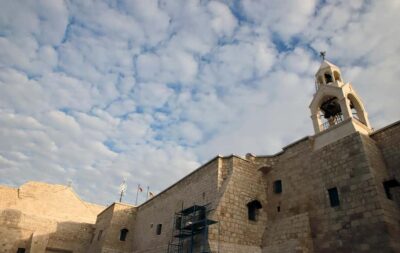
Day Tour to Jerusalem and Bethlehem from Tel Aviv
Read our review →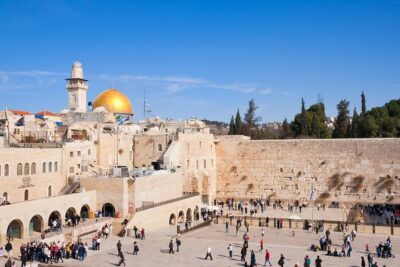
Jerusalem, Dead Sea, and Bethlehem from Tel Aviv
Read our review →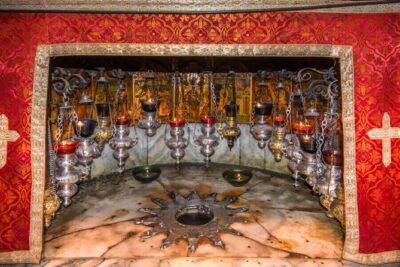
Jerusalem and Bethlehem Day Tour from Jerusalem
Read our review →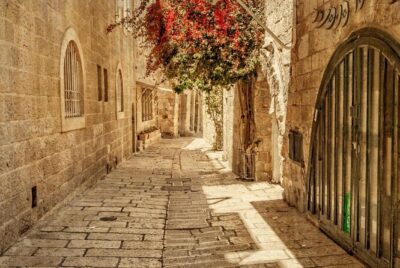
Ashdod Shore Excursion: Jerusalem and Bethlehem – for cruise ship guests only
Read our review →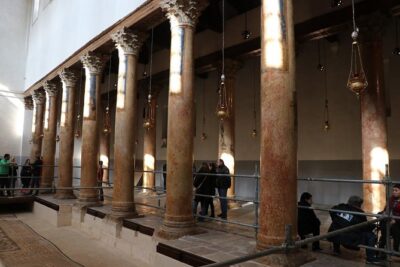
Travel From Jerusalem To Bethlehem and Dead Sea – Daily Group West Bank Tour
Read our review →
Travel To Bethlehem, Jericho & Jordan River – Group Guided Tour from Jerusalem
Read our review →Browse the lists this tour appears in