
Reviewed · JERUSALEM TOURS
In The Footsteps of Jesus Day Tour – Dguide Self Guiding App
Jerusalem’s most powerful Christian sites are strung across hills, valleys, markets, and ancient gates. This self-guided walking tour links them into one clear four-hour route, beginning at the Mount of Olives and ending at the Garden Tomb, one possible site of Jesus’ crucifixion and resurrection.
I like two things right away: you can move at your own pace, and the DGuide app lets you leave the route and return later. I also like the route’s quiet moments, especially the view from Dominus Flevit and the ancient olive trees at Gethsemane. The trade-off is that the app cannot answer questions or point out exact details in person, and one user found the information less detailed than expected.
In This Review
- Key points to know before you go
- A self-guided route through Jerusalem’s central Christian story
- Mount of Olives: begin with Jerusalem at your feet
- Dominus Flevit and the view of the Old City
- Gethsemane: ancient olive trees and a quieter pause
- The Tomb of the Virgin Mary in the Kidron Valley
- Bethesda and the acoustics of St. Ann’s
- The Via Dolorosa and the Austrian Hospice
- Damascus Gate and the change from old city to open road
- The Garden Tomb: a quiet ending with an important distinction
- Is four hours enough for the full route?
- What the $7 price really buys you
- Who should choose this walk?
- Should you book In The Footsteps of Jesus?
- FAQ
- How long does the tour take?
- Where does the tour begin?
- Where does the tour end?
- Is the DGuide app included?
- Is the Garden Tomb open every day?
- Are entrance fees included?
Key points to know before you go
- Start above Jerusalem at the Mount of Olives: The tour opens with a sweeping view before walking down the Palm Sunday Road.
- Follow a meaningful Christian route: You visit Dominus Flevit, Gethsemane, the Tomb of the Virgin Mary, Bethesda, the Via Dolorosa, Damascus Gate, and the Garden Tomb.
- Use your own pace: The DGuide app is free after booking, and your coupon code appears in the Before You Go section of your confirmation email.
- Plan for hills and stairs: This is a walking tour through uneven city streets, a valley, stairways, and market lanes. Moderate fitness is needed.
- Budget for two small extras: St. Ann’s and the Pools of Bethesda charge 5 shekels, and the Austrian Hospice rooftop also uses a 5 shekel turnstile.
- Check the Garden Tomb schedule: It is closed Sunday and Monday. You can still follow the route then and return Tuesday through Saturday.
A self-guided route through Jerusalem’s central Christian story
The route was designed by Uri Goldflam, a professional guide and educator with 30 years of guiding experience and the founder of Travel Trailer Israel. His work gives the tour a clear structure, but the experience is still yours to manage.
You download the free DGuide app and use the coupon code supplied after booking. From there, you can follow the suggested route, stop the commentary when you wish, and take a detour without losing your place.
That freedom matters in Jerusalem. A church may be open when you arrive, crowded a few minutes later, or especially quiet when you least expect it. A fixed group tour has to keep moving. With this one, you can pause for a view, prayer, coffee, or a closer look at old stonework.
The limitation is just as clear. You are responsible for opening the app, following directions, and deciding how much information you want. If you want a guide beside you to explain a confusing site or answer a question, this will feel spare. One available assessment found the tour acceptable but wanted more detail about how, when, and where events took place. I would treat the app as a well-planned companion, not a full replacement for a live guide.
A few more Jerusalem trips to weigh up
- Classic Jerusalem Old City Tour – Dguide Self Guiding App
★ 5.0 · 9 reviews - From Tel Aviv: Dead Sea Self-Guided Chill-Out Day Trip
★ 4.2 · 64 reviews
Mount of Olives: begin with Jerusalem at your feet
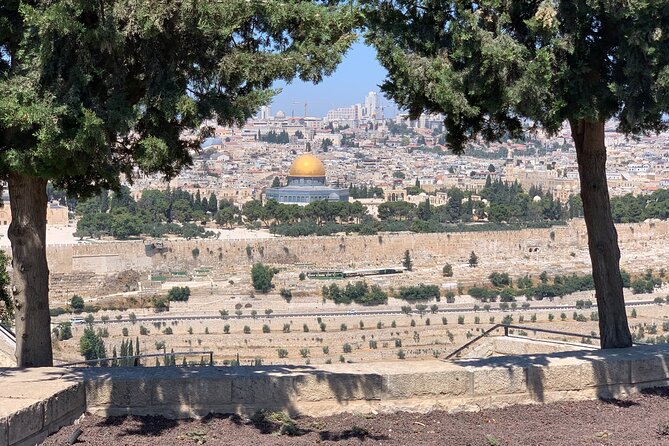
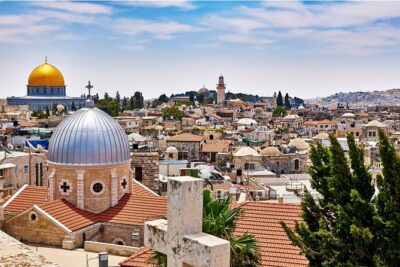
The meeting point is at Seven Arches on the Mount of Olives. This is a strong place to begin because Jerusalem’s Old City spreads out below you, with the major landmarks gathered in one wide view.
The app introduces the city here before leading you down the Palm Sunday Road. Give yourself time to get your bearings. This opening view helps the rest of the walk make sense, since you will later enter the Old City, cross through its markets, and finish outside the walls near Damascus Gate.
The observation area can be lively, with peddlers and often a camel available for rides or photographs. Be polite, keep control of your belongings, and do not feel pressured into buying anything. The stop itself is free and planned for about 15 minutes.
The route then heads downhill. That sounds easy, but Jerusalem’s slopes can be tiring, and the full outing includes more walking and stairs ahead. Wear shoes with good grip and save some energy for the Old City.
Dominus Flevit and the view of the Old City
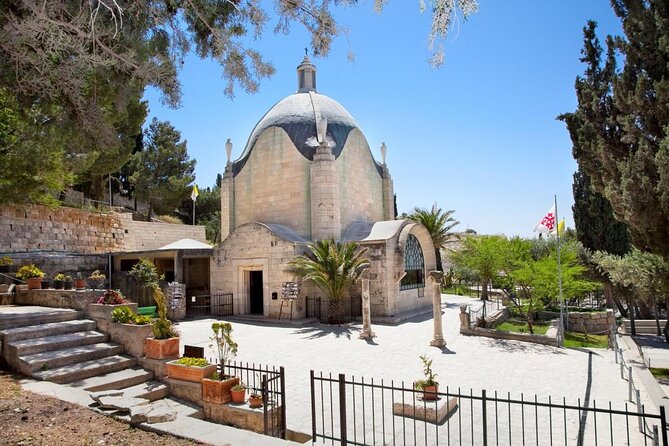
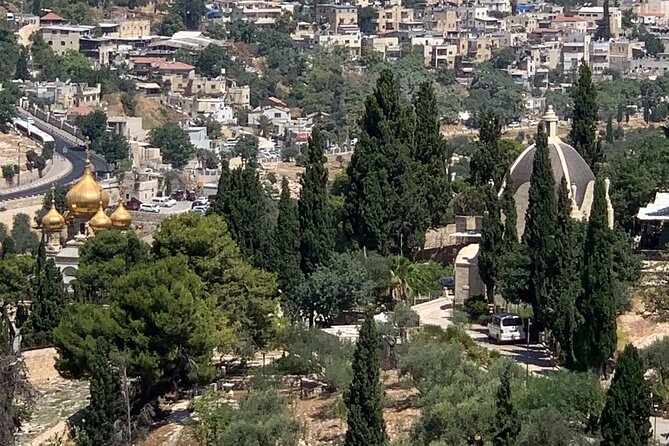
About 20 minutes are set aside at Dominus Flevit, a small church shaped like a teardrop. Its name refers to Jesus weeping as he foresaw Jerusalem’s destruction.
The church’s position is the real reward. From the adjacent viewing area, you look toward the Old City and the Church of the Holy Sepulchre. Inside, a special window frames the city, giving the site a direct visual link between Christian worship and Jerusalem’s skyline.
This is one of the best places to slow down. The route encourages silent meditation, and that advice makes sense here. You do not need a long lecture to understand why this stop matters. The view, the tear-shaped design, and the setting along the Palm Sunday Road do much of the work.
Because the tour is self-guided, you can linger beyond the planned 20 minutes if the church is open and the view holds your attention. Just remember that extra time can affect your arrival at later sites, particularly the Garden Tomb.
Gethsemane: ancient olive trees and a quieter pause
The Palm Sunday Road winds downhill toward the Kidron Valley. At the bottom, the route turns away from the noisy street into the Garden of Gethsemane.
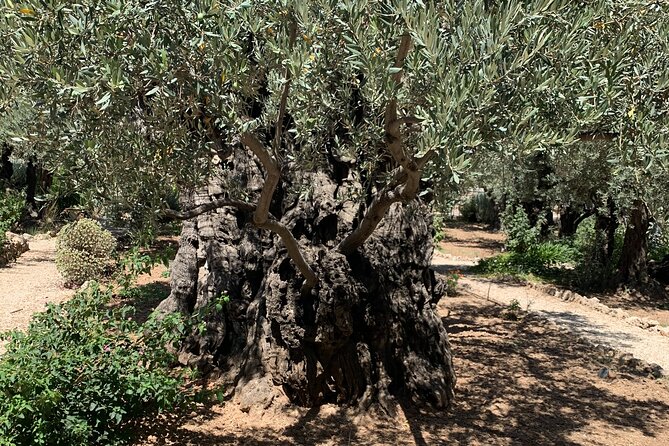
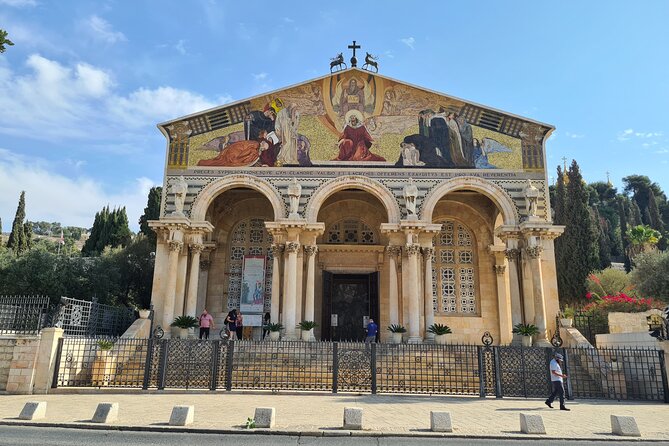
The garden contains olive trees described as hundreds or even thousands of years old. The Church of All Nations, also called the Church of the Agony, is built on the traditional site where Jesus prayed on the night of his arrest.
You have about 30 minutes here. That is enough for a calm look at the trees, a visit to the church if accessible, and time for personal reflection. This is one of the tour’s strongest stops because the setting feels different from the road above. The traffic and commercial activity fall away, replaced by a compact garden and heavy, old trees.
Do not expect every historical question to be settled for you. The site is traditional, as are many locations connected with the final days of Jesus in Jerusalem. The value is in the combination of tradition, architecture, and atmosphere, not in a claim that every stone can be proved as the exact spot described in the Gospels.
Same coast, a completely different kind of day:
- From Jerusalem: Masada & Dead Sea Full Day Tour with Pick Up
★ 4.5 · 815 reviews - Masada and the Dead Sea Day Trip from Jerusalem
★ 4.5 · 757 reviews - From Jerusalem: Nazareth and Sea of Galilee Tour
★ 4.5 · 588 reviews - Nazareth and the Sea of Galilee Day Trip from Jerusalem
★ 4.5 · 446 reviews
The Tomb of the Virgin Mary in the Kidron Valley
The next stop takes you below street level to the Tomb of the Virgin Mary. About 10 minutes are planned here.
A broad stairway leads down to the crypt, which is described as a fine example of Crusader construction. On the right side of the stairway is the tomb of Queen Melisende of Jerusalem, daughter of King Baldwin II.
This is a short stop, but it adds useful architectural context to the walk. You are not simply moving from one Gospel scene to the next. Jerusalem’s Christian sites also reflect the medieval kingdoms, churches, and rebuilding campaigns that shaped the city.
The stairs are important to note. Anyone with limited mobility should think carefully about this route, since the tour requires stair use and moderate physical fitness. Even if you are comfortable walking, take care on the descent and climb back up at your own pace.
Bethesda and the acoustics of St. Ann’s
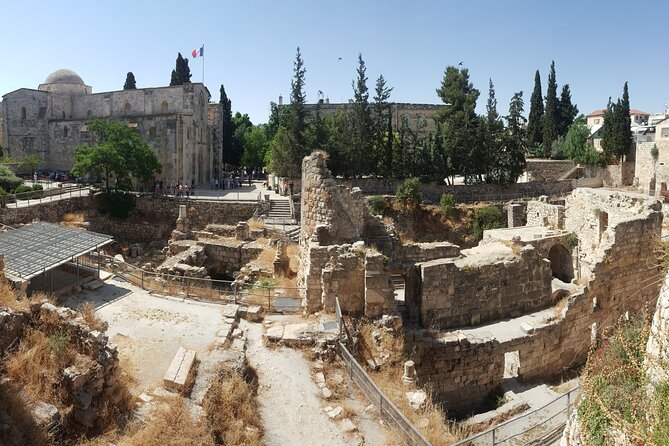
From the Kidron Valley, the route continues to the Pools of Bethesda. This is the setting connected with the Gospel of John and the healing of a man who had been unable to walk for 38 years.
The stop lasts about 40 minutes and includes the adjacent Church of St. Ann. The church is known for its neoclassical design and excellent acoustics. If singing or spoken sound carries through the interior, you will quickly understand why this church is often singled out as a special place to hear the building itself.
Admission to the Pools of Bethesda and St. Ann’s is not included. The stated fee is 5 shekels per person, so the extra cost is modest, but carry some local currency if you want to enter.
This is a good example of why the tour’s flexible format helps. You may want only a quick look at the ruins, or you may want time inside St. Ann’s to appreciate the sound. The app can provide the background, but you decide how long the physical site deserves.
The Via Dolorosa and the Austrian Hospice
From Bethesda, you begin walking along the Via Dolorosa, known as the Way of the Suffering or the Passion of Christ. The stations are marked by round bronze plates, which help you follow the route through the Old City.
This section is less serene than Gethsemane. The path runs through market streets, and the route can feel crowded and noisy. That contrast is part of the experience. You move from biblical settings and churches into the daily movement of the Old City, where religious history and ordinary commerce share the same narrow lanes.
The Austrian Hospice provides a welcome pause. Large wooden doors open onto a small piece of European hospitality near the Via Dolorosa. A rooftop view is available through a 5 shekel turnstile, and the stop also suggests coffee and the hospice’s apple strudel.
The planned time here is 45 minutes, which is generous compared with most stops. Use it well. The rooftop gives you another angle on Jerusalem, while the café provides a practical rest before the final walk to the Garden Tomb.
The hospice costs extra, and the café purchase is not included. Still, this is a useful place to spend a little money if you need a break. The route has already taken you downhill, through a valley, up into the Old City, and through several stairways and lanes.
Damascus Gate and the change from old city to open road
After the Austrian Hospice, follow the market alley slightly uphill until you exit through Damascus Gate. The gate you see today belongs to the Ottoman construction of Jerusalem’s walls, dating to about 1536. Below it are remains of earlier Roman-period gates.
This stop is planned for 20 minutes. It gives you a chance to look back at the layers of the city before leaving the Old City behind.
Damascus Gate is also an important practical marker. Once outside, you follow the road toward the Garden Tomb. The route shifts again, from the tight lanes of the Old City to a more open approach.
The app’s ability to let you pause or wander can be helpful here, but you should keep track of the route. The Garden Tomb is the final stop, and its opening schedule matters more than any other part of the walk.
The Garden Tomb: a quiet ending with an important distinction
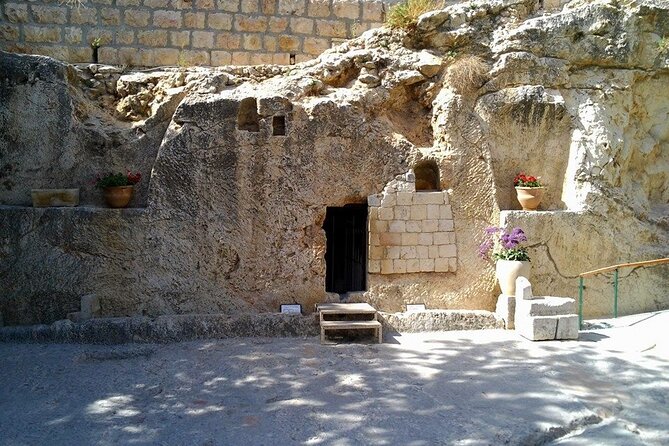
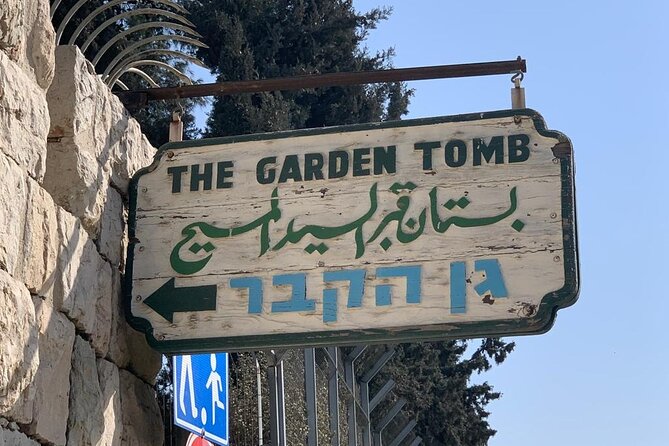
The tour ends at the Garden Tomb, identified in the late 19th century as one possible location for Jesus’ crucifixion, burial, and resurrection.
The garden is managed by the Protestant Garden Tomb Association, a charitable trust based in the United Kingdom. Inside, you can see the skull caves associated with the hill of Golgotha, enter the empty tomb, and find quiet corners and chapels for prayer, communion, or reflection.
About an hour is planned here. That gives you time to absorb the full route rather than rushing through a final photograph. The Garden Tomb is free to enter, but group visits require a reservation. The route is intended for a maximum of two people, so it is naturally suited to a pair or a very small party.
It is worth keeping the wording possible location in mind. The Garden Tomb is not the only site associated with Jesus’ burial and resurrection. The tour presents it as one traditional possibility, which lets you appreciate the place without confusing religious tradition with certainty.
The Garden Tomb is closed Sunday and Monday. If those are the only days you have, you can still complete the walk and return later, Tuesday through Saturday. The published operating information also lists Monday through Thursday hours of 8:00 a.m. to 5:00 p.m., so check the schedule before setting out, especially if your visit falls near a holiday or seasonal change.
From the Garden Tomb, you can walk back toward the Old City or continue uphill toward hotels and restaurants in the New City. That makes the end point useful rather than awkward. You can finish with a meal, return to your accommodation, or continue exploring.
Is four hours enough for the full route?
The stated duration is about four hours. The individual stop times add up to roughly three hours, leaving the rest for walking between sites, handling stairs, entering buildings, and finding your way through the Old City.
That schedule is realistic if you keep moving and do not linger too long at every church. It becomes tight if you want extended prayer time, a long café break, or a detailed look at every architectural feature.
I would begin early enough to avoid feeling rushed. The route starts at the Mount of Olives and ends at the Garden Tomb, so plan your transport to the Seven Arches rather than assuming the start and finish are close together. The tour is near public transportation, but parking fees are not included.
Bring water, modest clothing for religious sites, and a phone with enough battery for four hours of navigation and audio. Since the experience depends on the DGuide app, downloading what you need before walking is sensible, although the supplied information does not specify whether the tour works offline.
What the $7 price really buys you
At $7 per person, this is an inexpensive way to organize a demanding Jerusalem route. You are paying for access to Uri Goldflam’s planned content and route through the DGuide platform, not for a live guide, private transportation, entrance tickets, or personal assistance.
That price looks good if you want structure but do not need company. You get a logical sequence of major sites, a route that ends at a meaningful destination, and the ability to choose your own pace.
The extras are small but worth noting. Bethesda and St. Ann’s cost 5 shekels, the Austrian Hospice rooftop costs 5 shekels, and food or coffee at the hospice costs more. Parking is also excluded.
The value is weaker if you expect exact site-by-site historical detail or a guide who can answer questions. The app gives you independence, but it also puts the burden of interpretation on you. If the most important part of a tour is human conversation, spend more for a live guide. If flexibility matters most, the low price is appealing.
Who should choose this walk?
I would recommend it most strongly to couples, solo visitors, and independent pilgrims who want a clear route through Jerusalem’s Christian sites.
It suits you if you:
- Want to walk rather than ride between sites
- Prefer stopping for prayer, photos, or coffee on your own schedule
- Are comfortable using a phone app for directions and commentary
- Can manage hills, stairs, and several hours on foot
- Want to visit the Garden Tomb without joining a larger group
- Appreciate a low-cost introduction to the Mount of Olives, Gethsemane, Bethesda, and the Via Dolorosa
I would hesitate if you need wheelchair-friendly access, dislike navigating with a phone, or want a detailed discussion of biblical geography and historical evidence. The route includes stairs and uneven walking, and the available description does not promise step-free access.
The tour also works best when you accept that several sites are traditional locations. Its purpose is to connect the places and stories, not to settle every question about exact historical location.
Should you book In The Footsteps of Jesus?
Book it if you want a flexible, low-cost walking route that links Jerusalem’s major Christian sites without committing to a live group schedule. The best parts are the opening view from the Mount of Olives, the calm garden at Gethsemane, the Old City route, and the quiet ending at the Garden Tomb.
Do not book it expecting a personal guide or a long scholarly explanation at every stop. The app format is convenient, but one clear weakness is limited detail for anyone who wants precise historical context.
Check the Garden Tomb’s Tuesday through Saturday opening days before you pay. If your schedule allows that return visit and you are ready for hills and stairs, this is a practical way to place Jesus’ final days within Jerusalem’s streets, churches, gates, and gardens.
FAQ
How long does the tour take?
The tour lasts approximately four hours, including the route between the eight stops.
Where does the tour begin?
It begins at Seven Arches on the Mount of Olives in Jerusalem.
Where does the tour end?
It ends at the Garden Tomb on Conrad Schick Street in Jerusalem. From there, you can walk back to the Old City or uphill toward New City hotels and restaurants.
Is the DGuide app included?
The DGuide app is free. After booking, you receive a coupon code to access the In the Footsteps of Jesus tour. The code is in the Before You Go section of the confirmation email.
Is the Garden Tomb open every day?
No. The Garden Tomb is closed Sunday and Monday. You can take the route on those days and return to the Garden Tomb Tuesday through Saturday.
Are entrance fees included?
Most stops are free, but the Pools of Bethesda and St. Ann’s charge 5 shekels per person. The Austrian Hospice rooftop uses a 5 shekel turnstile. Parking fees are not included.
Just added around Jerusalem
- Tour of Jerusalem & Dead sea private tour★ 5.0 · 4 reviews
- full day tour Jerusalem price per van up to 6 people★ 5.0 · 8 reviews
- jerusalem classic tour★ 5.0 · 3 reviews
- West Bank Tour from Jerusalem and Tel-Aviv – Bethlehem & Jericho★ 5.0 · 6 reviews
- Privet Tour – FROM JERUSALEM TO JERICHO & THE DEAD SEA★ 5.0 · 8 reviews
- Experience Shabbat With Dinner In Jerusalem★ 5.0 · 5 reviews
- Private Tour: Old City of Jerusalem Christianity Tour★ 5.0 · 5 reviews
- Private Silk Painting Workshop in Jerusalem – Create a scarf –★ 5.0 · 4 reviews
Jerusalem Tours, compared.

From Jerusalem: Masada & Dead Sea Full Day Tour with Pick Up
Read our review →
Masada and the Dead Sea Day Trip from Jerusalem
Read our review →
From Jerusalem: Nazareth and Sea of Galilee Tour
Read our review →
Nazareth and the Sea of Galilee Day Trip from Jerusalem
Read our review →
From Jerusalem: Masada&Dead Sea Tour INCLUDING ENTRANCE FEES
Read our review →
Browse the lists this tour appears in