
Reviewed · FULL-DAY
Full Day Private Christian Tour in Jerusalem with Tour Guide
Jerusalem’s power comes into focus on foot. This private Christian tour follows the traditional route from the Mount of Olives to the Old City, linking prayer, betrayal, trial, crucifixion, and resurrection in one long day. I like the sweeping first view of Jerusalem, and I like the way the route connects churches and streets instead of treating them as isolated stops.
The main consideration is stamina. You will walk downhill from the Mount of Olives, then climb into the Old City and follow crowded, uneven lanes. The $700 price is for up to five people, so it makes better sense for a small family or group than for one or two people traveling on a tight budget.
In This Review
- Key points to know before booking
- Starting above Jerusalem on the Mount of Olives
- Ascension and the Lord’s Prayer
- Walking the Palm Sunday route downhill
- Dominus Flevit and the view Jesus saw
- Gethsemane and the Church of All Nations
- The Tomb of the Virgin Mary
- Entering the Old City through the Lion’s Gate
- The first nine Stations of the Cross
- The Church of the Holy Sepulchre
- The Western Wall closes the day
- Is $700 good value for a private day?
- Practical advice for making the day work
- Who should book this Jerusalem tour?
- FAQ
- How long does the tour last?
- How much does the tour cost?
- Is this a private tour?
- Is pickup available?
- Is lunch included?
- Which major Christian sites are included?
- Does the tour visit the Western Wall?
- Can I cancel for a full refund?
Key points to know before booking
- A full route through Christian Jerusalem: Follow the traditional Palm Sunday route, visit Gethsemane, and trace the Via Dolorosa to the Church of the Holy Sepulchre.
- A private day with Simon: The guide is praised for patience, humor, flexibility, and an ability to keep both children and adults involved.
- Nine major stops in about 10 hours: The day is packed, with roughly nine hours and 25 minutes assigned to the listed visits before allowing for walking and other delays.
- A strong choice for families: Simon has experience adjusting the pace for children and making long days work in hot weather.
- Three faiths in one walk: The route includes important Christian, Jewish, and Muslim sites, including the Dome of the Rock, Western Wall, and Holy Sepulchre.
- A group price, not a per-person fare: At $700 for up to five people, the effective cost is $140 each for a full group of five.
Starting above Jerusalem on the Mount of Olives
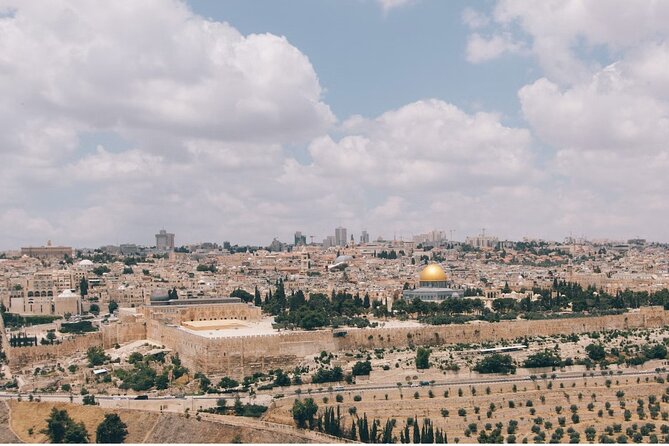
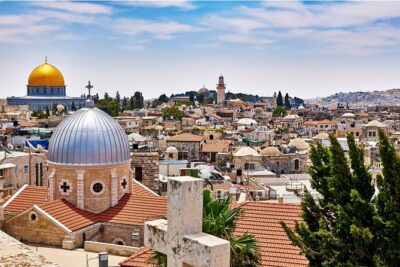
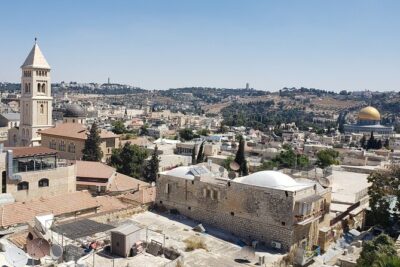
The day begins with a panoramic outlook over Jerusalem’s Old City. This is the right place to get your bearings, since the view brings several major landmarks into one frame: the gold-topped Dome of the Rock, the dome of the Church of the Holy Sepulchre, and the Hurva Synagogue.
The Dome of the Rock is one of Islam’s most important holy places. The Church of the Holy Sepulchre marks the Christian site associated with Jesus’ crucifixion and resurrection. The Hurva Synagogue is the largest Jewish synagogue in the Old City. From this first viewpoint, Jerusalem’s religious story is already visible as a shared, and often contested, city.
You have about 45 minutes here. That is enough for an explanation and photographs without turning the opening stop into a long wait. I would pay close attention to the guide’s orientation talk, because the rest of the day makes more sense once you understand the hills, walls, and major quarters below.
A few more Jerusalem trips to weigh up
- From Jerusalem: Masada & Dead Sea Full Day Tour with Pick Up
★ 4.5 · 815 reviews - Full Day City Tour of Jerusalem
★ 4.1 · 367 reviews - Old and New Jerusalem Full-Day Tour
★ 4.0 · 273 reviews
Ascension and the Lord’s Prayer
The next two stops focus on places linked with Jesus’ teachings and resurrection. At the Chapel of the Ascension, you visit the traditional site where Jesus is believed to have ascended to Heaven 40 days after the Resurrection. The visit lasts about 30 minutes and admission is listed as free.
You then walk to the Pater Noster Church, associated with Jesus teaching the Lord’s Prayer. The church is especially meaningful for Christian pilgrims who want to connect familiar scripture with a physical place. The experience is not simply a quick photograph. It gives you time to consider how prayer and teaching fit into the final-week route.
The combined walk and visit at Pater Noster takes about an hour and 50 minutes. That is one of the longer portions of the day, and it begins the physical challenge of the tour. Wear shoes that can handle stone paths and slopes. The route is manageable for most people, but you should not treat this as a drive-by sightseeing day.
Walking the Palm Sunday route downhill
From the Mount of Olives, the tour follows the traditional path associated with Jesus’ entry into Jerusalem on Palm Sunday. The route descends toward the Old City, giving you a direct sense of the terrain described in the Gospels.
Along the way, you pass the Jewish cemetery on the Mount of Olives. It is described as roughly 3,000 years old, with tombs connected to figures including Absalom, prophets Haggai, Malachi, and Zechariah, as well as former Prime Minister Menachem Begin.
This section is valuable because the guide can connect the view, the slope, and the biblical account as you move through the area. You are not just being driven between religious buildings. You are walking the route itself, which makes the setting easier to picture.
At the same time, downhill walking can be hard on knees, and the later climb into the Old City is still ahead. If you need frequent pauses, tell Simon early. His reputation for patience and adjusting the pace is one of the strongest reasons to choose a private tour rather than a fixed group outing.
Dominus Flevit and the view Jesus saw
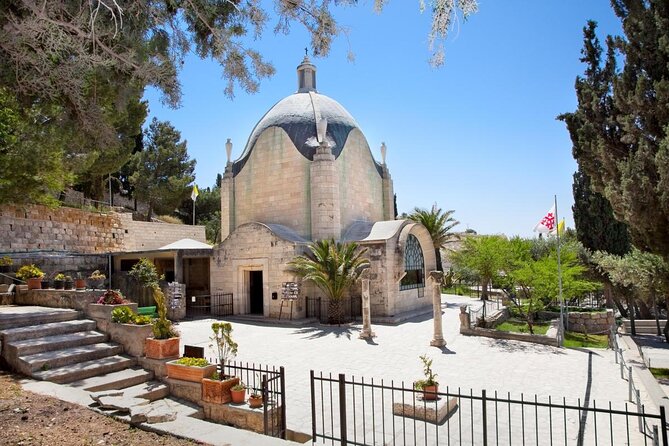
Dominus Flevit Church is linked with the account of Jesus weeping over Jerusalem. The church also recalls passages in which Jesus foretold the destruction of Jerusalem and spoke about the end of the world shortly before his crucifixion.
You have about 50 minutes here. The architecture is a major part of the stop, but the view matters just as much. The church’s setting helps explain why Jerusalem carried such emotional and religious weight in the Gospel accounts.
This is a good point in the day to slow down. The tour has already covered several traditions connected with Jesus, and the next stops become more solemn. A private guide can give you room for questions without forcing the whole group to move on at the same pace.
Same coast, a completely different kind of day:
- Masada and the Dead Sea Day Trip from Jerusalem
★ 4.5 · 757 reviews - From Jerusalem: Nazareth and Sea of Galilee Tour
★ 4.5 · 588 reviews - Nazareth and the Sea of Galilee Day Trip from Jerusalem
★ 4.5 · 446 reviews - From Jerusalem: Masada&Dead Sea Tour INCLUDING ENTRANCE FEES
★ 4.3 · 392 reviews
Gethsemane and the Church of All Nations
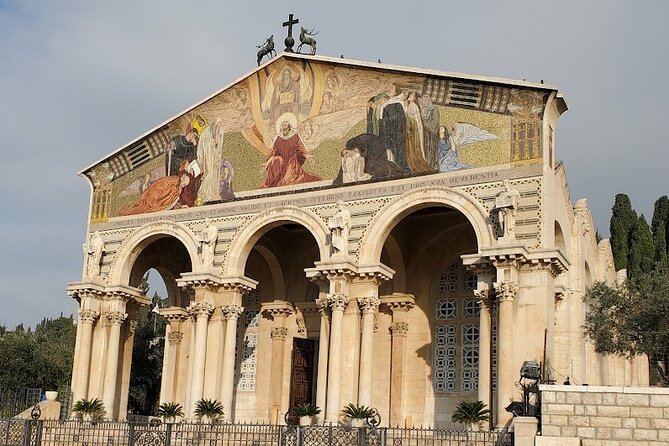
The traditional Garden of Gethsemane is the next major stop. According to the Gospel accounts, Jesus prayed here shortly before Judas Iscariot betrayed him. The name Gethsemane comes from an ancient Hebrew term meaning oil press, a reminder of the area’s connection with olive cultivation and pressing.
Today, the site includes the Church of All Nations, also called the Church of the Agony. Its vaulted ceilings and stained-glass windows create a darker, more reflective mood than the open views on the Mount of Olives.
The scheduled visit is about 20 minutes, so this is a short stop. Church access and crowd levels can affect how much time you have inside, but the location itself carries much of the meaning. If you are visiting as a pilgrim, this may be one of the most important moments of the day. If you are approaching the tour mainly as a cultural or historical outing, Simon’s explanations help place the religious tradition in context.
The Tomb of the Virgin Mary
The tour continues to the traditional Tomb of Mary, the mother of Jesus. Next to it is a grotto associated with the belief that Jesus spent his last night there.
The visit is allotted about an hour and 25 minutes, making it one of the longer indoor portions of the route. The stop adds a Marian dimension to a day otherwise centered on Jesus’ final week. It also shows how Jerusalem’s sacred sites often carry several layers of tradition, with different communities attaching meaning to adjoining spaces.
The route is not designed as a quick list of famous buildings. Time is given to prayer, explanation, and quiet observation. Still, the overall schedule is ambitious. Nine stops in one day means you should expect a steady pace and limited freedom to linger at every site.
Entering the Old City through the Lion’s Gate
After the Mount of Olives, the route climbs toward the Old City and enters through the Lion’s Gate. This is where the Via Dolorosa section begins.
The climb is important to understand before you book. You will already have walked down the Mount of Olives, and now you are going uphill into the Old City. Jerusalem’s old streets are not laid out for easy modern walking. Stone paving, stairs, narrow passages, and crowds can make the route tiring even when the distance looks short on a map.
The private format helps here. Simon can explain what you are seeing, stop for questions, and adjust the rhythm for your group. His past tours have included families with young children and teenagers, and his approach is described as patient, humorous, and attentive to different ages.
The first nine Stations of the Cross
The Via Dolorosa follows the traditional route from Jesus’ condemnation by Pontius Pilate to the place of crucifixion. You visit the first nine Stations of the Cross, including:
- The place where Jesus was condemned to death
- The point where Jesus was made to bear the cross
- The location associated with his first fall
- The place where Jesus met his mother
- The Chapel of Simon of Cyrene
- The location associated with Veronica wiping Jesus’ face
- The places linked with his second and third falls
- The point where Jesus spoke to the women of Jerusalem
The route includes the Church of the Flagellation, the Church of the Imposition of the Cross, Ecce Homo, the Church of Our Lady of Sorrows, and the Chapel of Simon of Cyrene. Some locations are churches or chapels, while others are marked by streets, plaques, or traditional points along the way.
You have about an hour and 45 minutes for this section. It is a central strength of the experience because the walking route gives the Passion story a clear sequence. You move through the same narrow urban setting rather than hearing the stations as disconnected facts.
Crowds are the main challenge. The Via Dolorosa is a working part of the Old City, not a private religious compound. Shopkeepers, residents, worshippers, and other tour groups share the lanes. You should expect interruptions and a less peaceful setting than you might imagine from a devotional painting.
The Church of the Holy Sepulchre
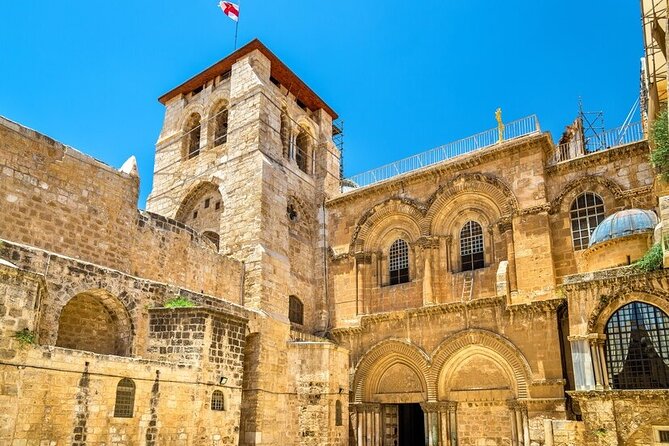
The tour’s emotional center is the Church of the Holy Sepulchre. Christian tradition identifies this as the site of Jesus’ crucifixion and resurrection. Inside, you visit the final five Stations of the Cross:
- Jesus is stripped of his garments
- Jesus is nailed to the cross
- Jesus dies on the cross
- Jesus is taken down from the cross
- Jesus is placed in the sepulcher
You have about an hour here. That may feel brief if lines are long or you want extended time for prayer, but it gives the day a clear focus. The building is shared by several Christian communities, and its chapels, shrines, and rituals can feel complex at first. A guide is especially useful here because the significance of each area is not always obvious.
This is not a polished museum experience. The church can be crowded, solemn, confusing, and intensely personal all at once. I like that the tour treats it as a place of pilgrimage rather than just another landmark. You should also be prepared for the possibility that the visit feels rushed if access is slow.
The Western Wall closes the day
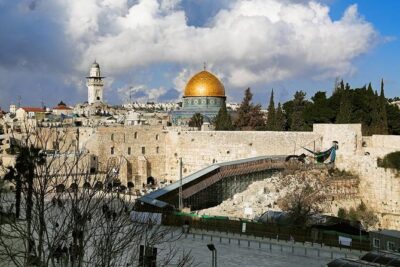
The final stop is the Western Wall, Judaism’s holiest prayer site and the last remaining section associated with the ancient Temple compound destroyed in AD 70.
Ending here gives the day a wider meaning. You begin with Jerusalem viewed from above, follow a Christian pilgrimage route into the Old City, and finish at one of Judaism’s most sacred places. The Dome of the Rock, the Holy Sepulchre, the Hurva Synagogue, and the Western Wall all appear within the same day, but the tour does not pretend they represent one single tradition.
You have about an hour at the wall. Dress and behave respectfully, and be ready for a religious setting rather than a conventional sightseeing stop. The visit is free, as are the listed stops throughout the itinerary.
Is $700 good value for a private day?
The price is $700 per group of up to five, not $700 per person. For five people, that works out to $140 each. For two people, it becomes $350 each, so the value depends heavily on group size.
Private transportation is included, while lunch is not. The tour lasts about 10 hours, and the listed visits account for roughly nine hours and 25 minutes before extra walking and timing issues. You are paying mainly for a full day with a dedicated guide, private arrangements, and a carefully connected route, not for entrance tickets.
I see the strongest value for families, small church groups, and visitors who want to ask questions or shape the pace around their interests. The private setup also helps if your group includes children. Simon has been praised for keeping teenagers and parents engaged, bringing patience to family outings, and adjusting plans when a special request matters to the group.
For one or two people on a limited budget, a shared walking tour will likely cost less. The tradeoff is less control and less personal attention. If Jerusalem is a once-in-a-lifetime pilgrimage, the private price may be easier to justify.
Practical advice for making the day work
The tour is listed for Monday, with hours from 8:00 AM to 6:00 PM. Pickup is offered, and private transportation is included. The exact meeting arrangements should be confirmed when you book.
Bring water, sun protection, and sturdy walking shoes. The itinerary includes a long downhill walk, a climb into the Old City, and extended time on stone streets. Lunch is not included, so plan for that gap with the guide before the day begins.
The tour is described as suitable for most people and near public transportation. That does not remove the physical demands of the route. If stairs, slopes, or long walks are difficult for you, ask in advance how the day can be adjusted.
Simon’s past guiding style is a useful clue about what to expect. He speaks English, explains Israeli and Jewish subjects with clarity, uses humor, and has experience with both adults and children. He has also arranged special experiences for families, including a meeting with a rabbi for a Bat Mitzvah ceremony at Robinson’s Arch. That does not form part of this fixed Christian route, but it suggests that you can discuss personal needs before the day.
The tour has a five-star rating from 28 reviews and a 100 percent recommendation figure. Those numbers point to consistently strong guide service, especially Simon’s friendliness, flexibility, patience, and ability to make a long day enjoyable. They should not obscure the fact that Jerusalem can be hot, crowded, and physically demanding.
Who should book this Jerusalem tour?
Book it if you want Christian Jerusalem explained as a connected pilgrimage route, not as a string of unrelated stops. It is particularly well suited to a group of four or five, families with children, first-time visitors, and anyone who wants a private English-speaking guide for a major day in the city.
Think twice if you dislike religious sites, crowded lanes, or a packed schedule. You may also find the cost hard to justify with only one or two people.
I would choose this tour for a small group that values personal guidance and wants to cover the Mount of Olives, Gethsemane, the Via Dolorosa, the Holy Sepulchre, and the Western Wall in one day. I would not choose it simply because it is private. The real reason to book is the combination of a demanding but meaningful route and a guide, Simon, who appears especially good at making the day work for different ages and interests.
FAQ
How long does the tour last?
The tour lasts approximately 10 hours.
How much does the tour cost?
The price is $700 per group of up to five people.
Is this a private tour?
Yes. Only your group participates in the activity.
Is pickup available?
Yes. Pickup is offered, and private transportation is included.
Is lunch included?
No. Lunch is not included in the tour price.
Which major Christian sites are included?
The route includes the Chapel of the Ascension, Pater Noster Church, Dominus Flevit Church, the Garden of Gethsemane, the Tomb of the Virgin Mary, the Via Dolorosa, and the Church of the Holy Sepulchre.
Does the tour visit the Western Wall?
Yes. The Western Wall is the final listed stop.
Can I cancel for a full refund?
Yes, if you cancel at least 24 hours before the experience’s start time. Cancellations made less than 24 hours before the start time are not refunded, and changes within that period are not accepted.
Just added around Jerusalem
- Tour of Jerusalem & Dead sea private tour★ 5.0 · 4 reviews
- full day tour Jerusalem price per van up to 6 people★ 5.0 · 8 reviews
- West Bank Tour from Jerusalem and Tel-Aviv – Bethlehem & Jericho★ 5.0 · 6 reviews
- jerusalem classic tour★ 5.0 · 3 reviews
- Experience Shabbat With Dinner In Jerusalem★ 5.0 · 5 reviews
- Private Tour: Old City of Jerusalem Christianity Tour★ 5.0 · 5 reviews
- Privet Tour – FROM JERUSALEM TO JERICHO & THE DEAD SEA★ 5.0 · 8 reviews
- Private Silk Painting Workshop in Jerusalem – Create a scarf –★ 5.0 · 4 reviews
Full-Day, compared.
From Tel Aviv: Masada & Dead Sea Full Day Tour with Pick Up
Read our review →
From Jerusalem: Masada & Dead Sea Full Day Tour with Pick Up
Read our review →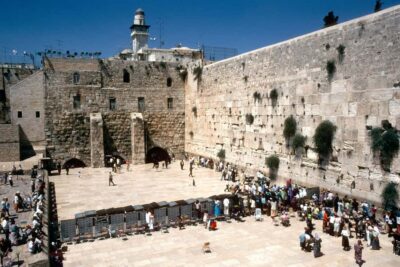
Jerusalem Full-Day Tour from Tel Aviv INCLUDING ENTRANCE FEES
Read our review →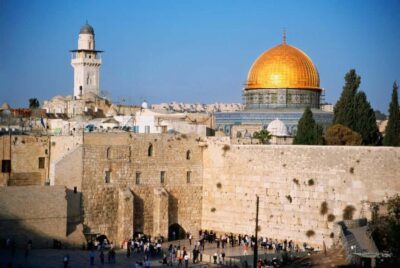
Jerusalem and Bethlehem Full-Day Tour from Jerusalem
Read our review →Browse the lists this tour appears in